
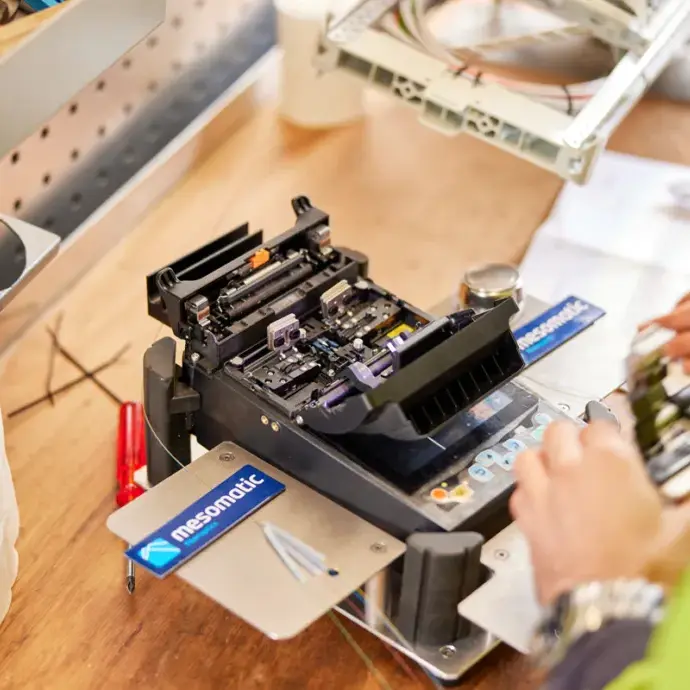
Splicing tool
Precision tools for the professional preparation and processing of optical fibres
Technical highlights
- Professional fibre-optic splicing tool
- Comprehensive range of tools
- Sturdy and durable construction
User highlights
- ✓ Clean fibre preparation
- ✓ Working more quickly and efficiently,
- ✓ Reducing fibre breaks and rework
Areas of application:
- FTTH installations
- FTTx networks
- Fibre-optic splicing work
- Telecommunications infrastructure
- Service and maintenance call-outs

Splicing tools are an essential part of any professional fibre-optic installation. Whether in the roll-out of FTTH networks, in data centres, telecommunications infrastructures or industrial networks, the quality of a fibre-optic connection begins with the careful preparation of the fibre. Professional splicing tools help technicians to carry out this step efficiently, precisely and consistently.
Before the actual splicing process begins, optical fibres must be cut to length, cleaned, prepared and precisely separated. Even the slightest errors during these steps can lead to increased attenuation, reflections or reduced long-term stability of the connection. High-quality splicing tools help to minimise such risks and create the conditions for optimum splice quality.
Depending on the application, various tools are used, such as fibre strippers, precision cleavers, cleaning tools, Kevlar scissors, fibre holders, protective sleeve installers or tool kits for fibre-optic installation. Each tool fulfils a specific function within the installation process and helps to ensure the quality of the finished connection.
A key advantage of professional splicing tools lies in their high precision. Modern tools enable precise work procedures and help installers achieve consistently high-quality results. This reduces the need for rework, increases efficiency on site and improves the reliability of the entire network infrastructure.
Splice tools are used in new installations as well as during maintenance and repair work. Network operators, installation companies and service organisations benefit from fast workflows and a high level of process reliability. Furthermore, professional tools help to ensure compliance with quality standards and installation guidelines.
Thanks to their robust construction, modern splicing tools are suitable for daily use in the field. They offer a long service life and help technicians carry out their work reliably, even in challenging environmental conditions. In this way, they make an important contribution to the successful deployment and operation of modern fibre-optic infrastructures.
Typical areas of application
• FTTH and FTTx networks
• Fibre preparation and fibre management
• Fusion splicing work
• Telecommunications networks
• Data centres and data centre infrastructure
• Backbone and access networks
• Maintenance and repair of fibre-optic networks
• Service and installation visits
Splicing tools combine precision, reliability and ease of use for professional fibre-optic work. Installation companies, network operators and service engineers benefit from high-quality tools for preparing and processing fibre-optic cables, thereby laying the foundations for high-performance, stable and future-proof communications networks.
Technical specifications and performance features of this product.
| Specification | Value |
|---|---|
| Product type | Splice tool set |
| Purpose | Preparation of optical fibres for fusion splicing |
| Suitable for fibre types | Single-mode / Multi-mode |
| Work stages | Stripping / Cleaning / Cleaving / Splicing |
| Tool components | Compatible with standard fibre-optic splicing machines |
| Compatibility | optimised for field and laboratory use |
| Material | Precision tools made of metal and plastic |
| Design | compact, portable design |
| Transport | Carry case or carry bag |
| Scope of application | FTTH / FTTx / Data centre / Telecommunications |
Accessories

Related products


Let us advise you!
Mesomatic Messtechnik AG, Martin Betschart · Sales Support / Product Manager
